The Legacy of Sir Isaac Newton
In the annals of history, one name stands out as a beacon of scientific brilliance – Sir Isaac Newton. Born on January 4, 1643, in Woolsthorpe, England, Newton was destined to become a giant in the realms of physics and mathematics. His early life was marked by an innate curiosity and an insatiable thirst for knowledge. As a young scholar at Trinity College, Cambridge, Newton delved into various subjects, from philosophy to astronomy, leaving no stone unturned in his pursuit of understanding the universe. His brilliance shone through his academic achievements, and he was appointed Lucasian Professor of Mathematics at Cambridge in 1669. It was during his time at Cambridge that Newton made one of his most significant breakthroughs – the development of calculus. Independently from the German mathematician Leibniz, he established the fundamental principles of this mathematical system, a feat that revolutionized mathematics and paved the way for countless scientific discoveries to come.
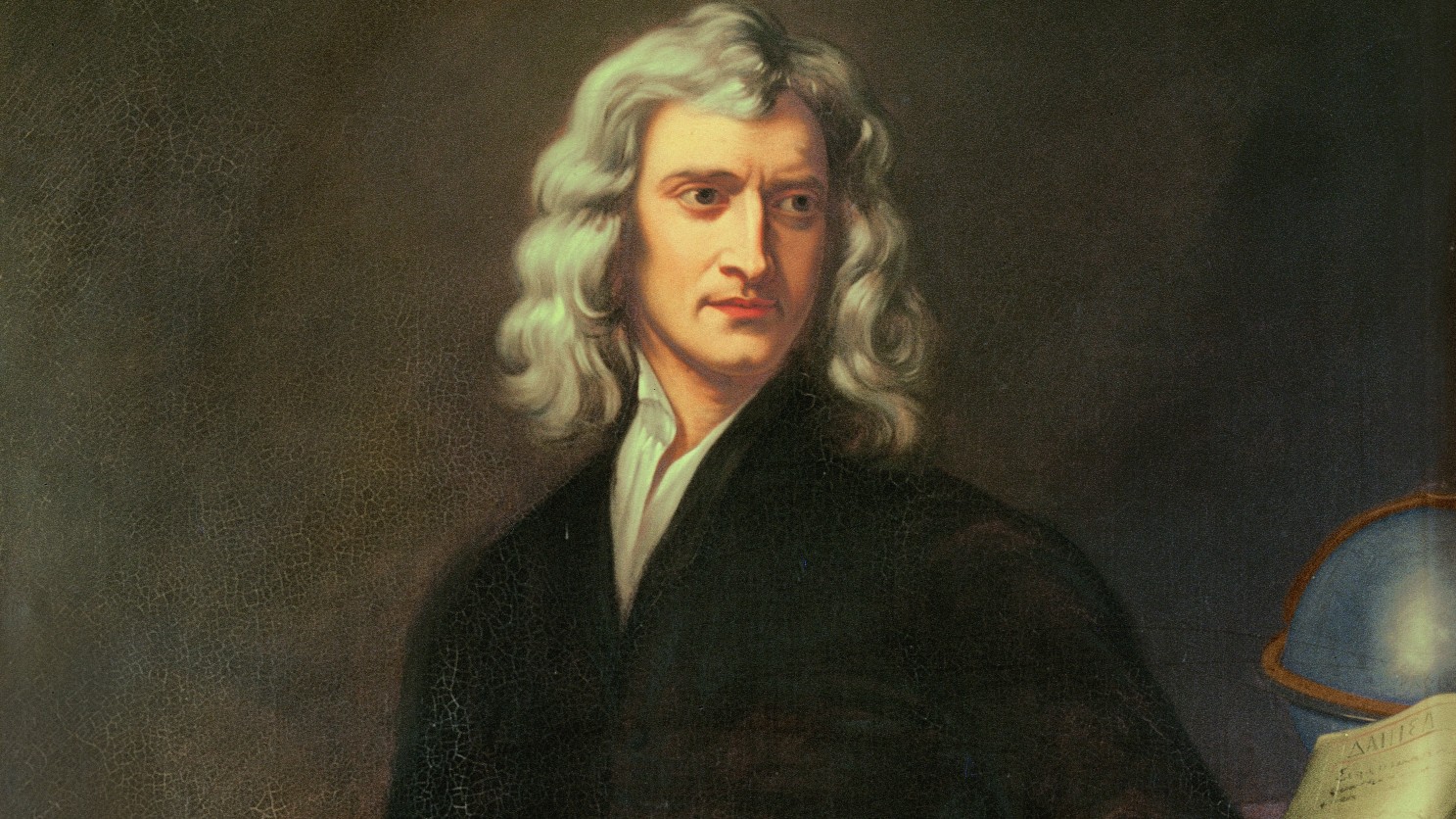
Newton's inquisitive mind also led him to explore the mysteries of light and optics. In 1672, he conducted groundbreaking experiments with prisms, demonstrating that white light is composed of a spectrum of colors. This laid the foundation for his monumental work, "Opticks," published in 1704, where he presented his theories on light, color, and the nature of reality. But it was the famous incident of the falling apple that led Newton to one of his most celebrated discoveries – the law of universal gravitation. As the story goes, the sight of an apple falling from a tree sparked Newton's thoughts about the forces governing the motion of celestial bodies. This event ultimately led him to publish his seminal work, "Philosophiæ Naturalis Principia Mathematica" (Mathematical Principles of Natural Philosophy), in 1687. In this magnum opus, Newton formulated the laws of motion and gravity, forever changing the course of science and our understanding of the cosmos.

Beyond his scientific achievements, Newton was known for his introverted nature and often eccentric behavior. He preferred solitude and spent long hours in contemplation and study. This reclusive demeanor did not detract from his standing among his peers, who recognized his genius and brilliance. Despite his academic prowess, Newton faced challenges throughout his career. He engaged in bitter disputes with fellow scientists, such as Robert Hooke and Gottfried Leibniz, over priority and recognition for certain discoveries. These controversies occasionally overshadowed his contributions, but history has cemented his position as one of the greatest minds to have ever graced humanity. In his later years, Newton received numerous honors, including a knighthood from Queen Anne in 1705. He was appointed President of the Royal Society in 1703, a position he held until his passing on March 20, 1727. Sir Isaac Newton's legacy endures to this day, inspiring countless generations of scientists and thinkers. His impact on science, mathematics, and the way we perceive the universe remains immeasurable. From the falling apple to the profound laws of motion and gravitation, Newton's legacy will forever illuminate the path of human knowledge and understanding.

Comentarios
Publicar un comentario